
Dishwashers do most of their work invisibly, and when they break, the symptom is rarely subtle. The good news is that most of the common dishwasher problems we see across our dishwasher repair service in Winnipeg trace back to one of seven failure patterns. Six of these common dishwasher problems have inexpensive fixes. The seventh is the one that tells you it might be time to replace the unit.
This guide walks through all seven common dishwasher problems in the order we encounter them, with the diagnostic test that tells you which problem you actually have. It also covers when to try a fix yourself and when the wiring, water supply, or pump assembly puts the job out of DIY range. If you are dealing with these complex issues, reaching out to appliance repair professionals in Winnipeg is the safest route.
The Seven Common Dishwasher Problems
1. Standing Water That Won’t Drain
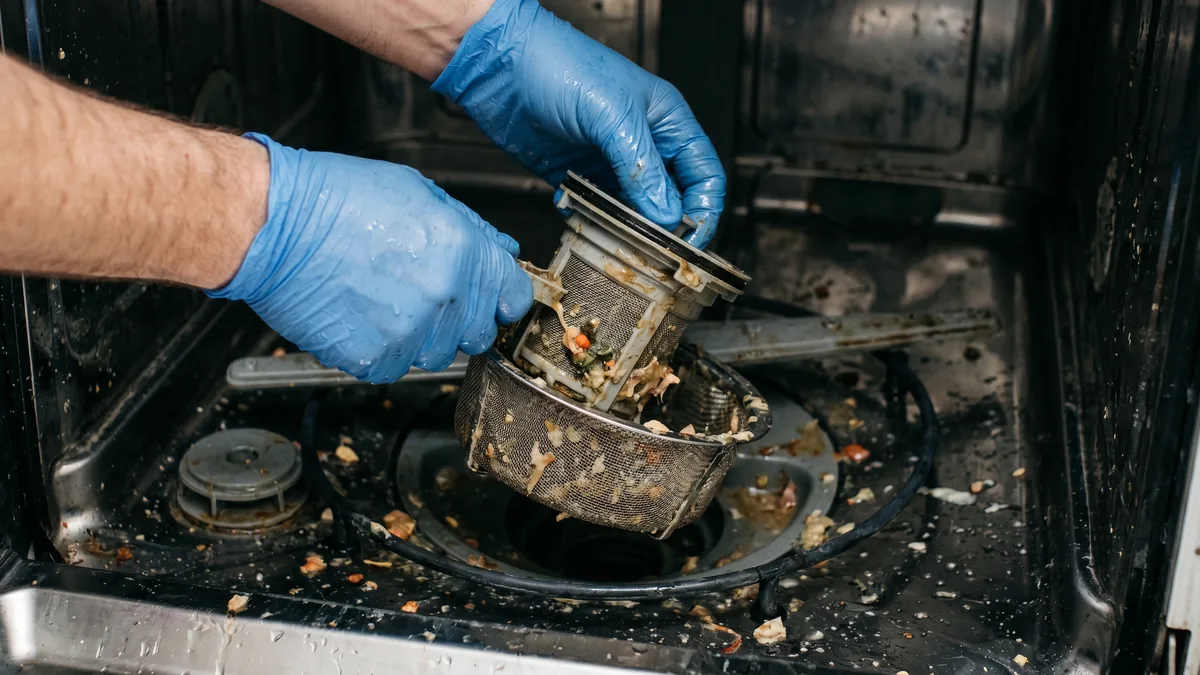
Of all the common dishwasher problems on this list, this is the most common service call we get, and the fix is the simplest. Pull out the bottom rack and lift the round drain filter assembly at the back-centre of the tub. In a household that does not pre-rinse dishes (which is fine, modern detergents prefer some food soil), the filter clogs with grease, paper labels, and small bits of debris every 4 to 6 weeks. A clogged filter slows the drain pump and leaves water sitting at the bottom after every cycle.
Rinse the filter under hot water, scrub the mesh screen with an old toothbrush, and put it back in. Run a short cycle empty to confirm. If water still pools, the next thing to check is the disposal (if your dishwasher drains through it) and the drain hose under the sink. About 70 percent of “wont drain” calls are solved before a technician ever needs to come out.
Did you know
The drain pump itself fails on about 1 in 10 dishwashers we see for a drainage complaint. Pump replacement runs 220 to 380 dollars depending on the brand. Before you spend that money, run a vinegar cycle and clean the filter twice. About a quarter of “failed pump” diagnoses turn out to be a tired pump straining against a heavy clog. Whether you need Frigidaire appliance repair, a quick fix for a faulty inlet valve requiring GE appliance repair, or specialized diagnostics for Samsung appliance repair, having an expert on-site prevents costly secondary damage.
2. Dishes Come Out Dirty Or Filmy
Two separate common dishwasher problems hide in the same complaint. Dirty dishes (visible food residue) point to spray arm or water temperature issues. Filmy dishes (cloudy but clean) point to water hardness or rinse aid.
For dirty dishes: spin the upper and lower spray arms by hand. They should rotate freely and have no clogged nozzles. Hold each arm up to the light and look for blocked holes. A toothpick clears most plugged nozzles. Then check water temperature. The dishwasher needs incoming water at 49 C (120 F) or warmer. Run the kitchen sink on hot for 30 seconds before starting a wash to flush cold water out of the supply line.
For filmy dishes, Winnipeg’s water hardness is in the moderate-to-hard range across most of the city, depending on neighbourhood and source. Hard water leaves mineral residue. Two fixes that actually work: keep the rinse aid dispenser full (modern detergent tabs do not substitute for liquid rinse aid), and run a monthly descaling cycle with citric acid or a commercial dishwasher cleaner. Vinegar alone is a weak descaler. A purpose-built product is roughly twice as effective.
3. Water Leaking Onto The Kitchen Floor
Stop the cycle immediately and shut off the water supply at the valve under the sink. A pinhole leak today becomes a 5,000 dollar floor repair if you let it run another month. Once the cycle is stopped, identify where the water is coming from.
The four common leak sources, in order of frequency:
- Door gasket. Run a finger around the rubber seal. Tears, missing chunks, or sticky food residue all cause leaks. Replacement gaskets are 40 to 90 dollars and most owners can install one with a screwdriver.
- Hose connections under the sink. Look for damp wood inside the cabinet. Tighten the inlet and drain fittings if you find them weeping.
- Drain hose clamp at the dishwasher end. Pull the kick plate (the strip across the bottom front) and look for water tracking down from the back.
- Pump seal failure. Leaks from the underside of the tub, with no visible source above, point at a worn pump seal. This is a technician job.
4. Won’t Start Or Stops Mid-Cycle
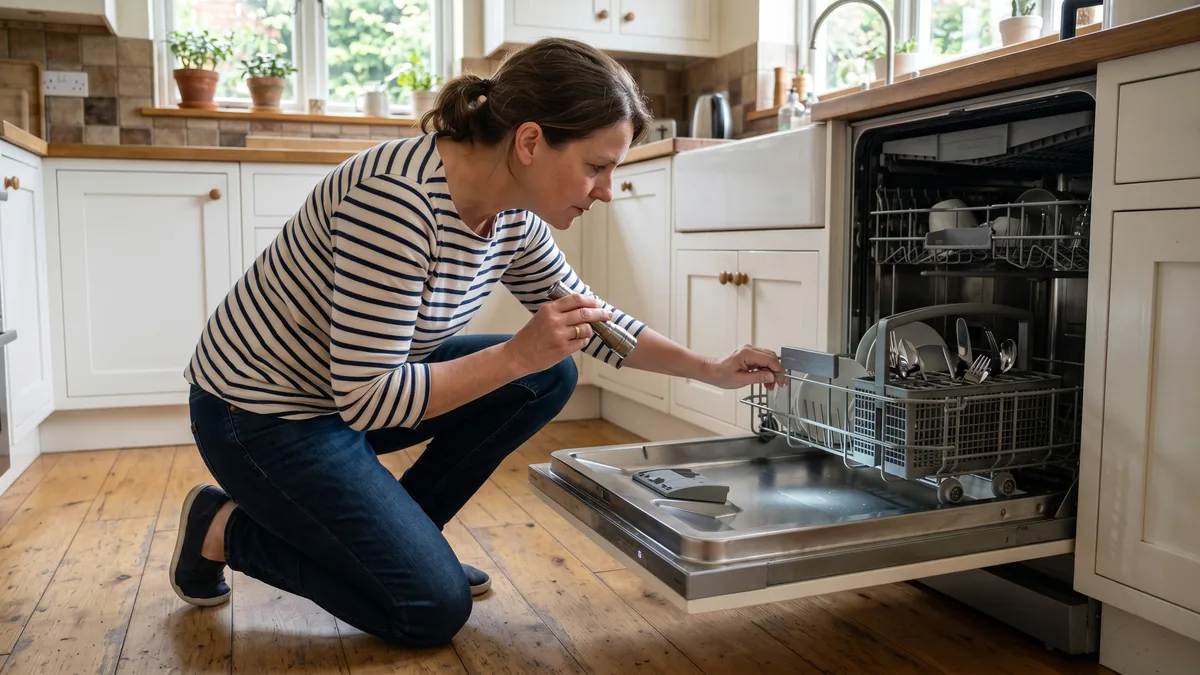
The most common cause is a worn door latch. The latch has a microswitch that tells the control board the door is closed. When the latch wears out (typically at 6 to 8 years), the switch reads “open” and the cycle never starts, or it stops as soon as the motor starts pulling. Open and close the door firmly and listen for a clean click. If the click is soft, mushy, or absent, the latch needs replacement.
Less commonly, the issue is the thermal fuse on the control board, which trips on overheating and locks the dishwasher out. A reset (breaker off for 30 seconds, then back on) clears the soft error states but does not fix a blown thermal fuse. If the unit stays dead after a reset and the door latch is firm, you are at a technician-level diagnostic.
People often ask
My dishwasher beeps, and the display shows an error code. What now? Pull up your model’s manual (most are available free as a PDF on the manufacturer website) and look up the code. Codes often point directly at the failed part: F01 leak detection, E15 inlet valve, F84 control board. Knowing the code before you call saves about half an hour of diagnostic time.
5. Loud Grinding Or Unusual Noise
A new noise from a dishwasher is almost always one of three things. The first is a foreign object near the chopper assembly at the bottom of the tub. Popcorn kernels, fruit pits, and small bones are the usual suspects. Open the door, look down at the chopper area, and remove anything stuck.
The second is a failing drain pump motor. A pump that hums but doesn’t move water is jammed or has a worn impeller. The third is a circulation pump bearing wearing out. That noise is a deep grinding sound that gets louder under the wash and rinse cycles. Bearing failure is a one-way trip toward pump replacement. The longer you run the unit, the more chance the bearing seizes and damages the motor windings.
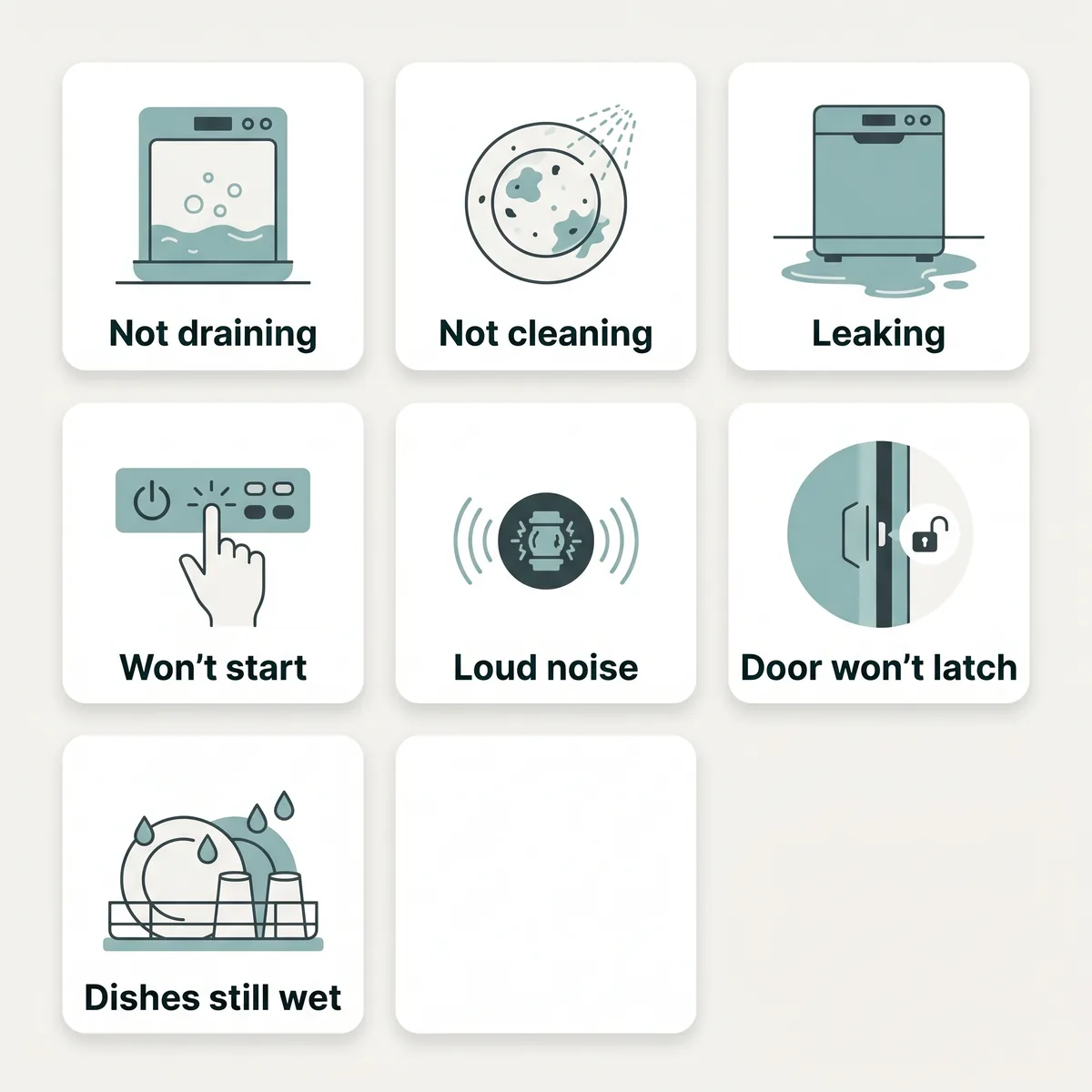
6. Door Won’t Latch Properly
If the door bounces back open when you push it shut, the strike plate (the metal piece on the dishwasher tub that the latch grabs) has shifted, or the latch itself is worn. Check the strike plate alignment first. It is held by two screws on most models and you can adjust the position by loosening, sliding, and re-tightening.
If alignment is correct but the latch still wont catch, the spring in the latch assembly has lost tension. Latch assemblies are 60 to 140 dollars depending on the model and the swap takes 20 minutes. While you are in there, check the front feet of the dishwasher. A unit that rocks slightly when the door is open will stress the latch over time. Levelling the unit with a wrench against the front foot adjusters fixes the underlying cause.
7. Dishes Still Wet At The End Of The Cycle
Modern dishwashers rely on rinse aid for sheeting (water rolling off the dishes instead of pooling), then a final heated rinse to dry. If your dispenser is empty, sheet drying doesn’t happen and items, especially plastic, come out wet. Fill the rinse aid reservoir.
If rinse aid is full and items are still wet, check that the “heated dry” option is selected on the cycle. Many of the eco-mode and quick-wash cycles skip the heated dry to save energy. Plastic items at the top rack will always need a towel wipe regardless of cycle, because plastic does not retain heat the way ceramic and glass do.
Save your money
Before you call about wet dishes, refill the rinse aid and run one full cycle on the normal setting with heated dry enabled. About 9 out of 10 “dishwasher wont dry” calls we get are solved with that one step. The cycle cost is about 60 cents, and you save a service call.
When To Call A Technician For Common Dishwasher Problems
The honest split for these common dishwasher problems. The repairs below are within reach for most homeowners with basic hand tools. Anything not on this list, particularly wiring, control boards, the inlet valve assembly, or pump replacement, is a technician job.
| Problem | Try at home | Call a pro |
|---|---|---|
| Filter clog | Yes, 5 minutes | Only if symptom persists after cleaning |
| Door gasket leak | Yes, 15 minutes with a screwdriver | If gasket replacement does not stop leak |
| Spray arm clog | Yes, 10 minutes with a toothpick | If arm wont rotate after cleaning |
| Rinse aid empty | Yes, 30 seconds | Never |
| Drain pump failed | Sometimes, if comfortable with appliance wiring | Recommended for most homeowners |
| Control board failure | No | Always |
| Pump seal leaking | No | Always |
| Inlet valve failure | No | Always (water line involvement) |
Manitoba Context: Water Hardness And Appliance Life
Winnipeg’s water hardness depends on the neighbourhood and the source. Most of the city ranges from moderately hard to hard, which is enough to put scale on heating elements and inside spray arms over time. Outside Winnipeg, communities served by groundwater (Brandon, Steinbach, Selkirk, Winkler) often run higher, and scale builds faster. If you have noticed a film on glassware over the last year, your dishwasher’s internals look much worse than your glasses do.
A monthly descaling cycle with a commercial dishwasher cleaner adds two to three years to the working life of the heating element, drain pump, and circulation pump. On a 1,200-dollar dishwasher amortised over 12 years, that maintenance habit is worth roughly 200 dollars in delayed replacement. The product itself costs 5 to 8 dollars a month.
For replacement decisions, ENERGY STAR-certified dishwashers use roughly 25 per cent less water and energy than 10-year-old models. Check before buying, the federal ENERGY STAR Canada directory lists current certified models.
The Bottom Line On Common Dishwasher Problems
Most common dishwasher problems are not actually broken dishwashers. They are clogged filters, empty rinse aid reservoirs, worn door latches, or scaled-up heating elements. The diagnostic flow for common dishwasher problems is consistent: stop the cycle, check the simple maintenance points first, then move to the wiring and pump assembly only if the basics check out. If you are facing one of the common dishwasher problems above and the home fix did not stick, we cover service across Winnipeg and the surrounding Manitoba communities.
If you are in Winnipeg, Brandon, Steinbach, Selkirk, or Winkler and one of these seven problems is still showing up after a home fix, we can usually book a service visit within the same week. Send us a note with your model number and a short description of the symptom, and we will give you a parts estimate before we arrive.
